
Healthy Vision Starts With a Dilated Eye Exam

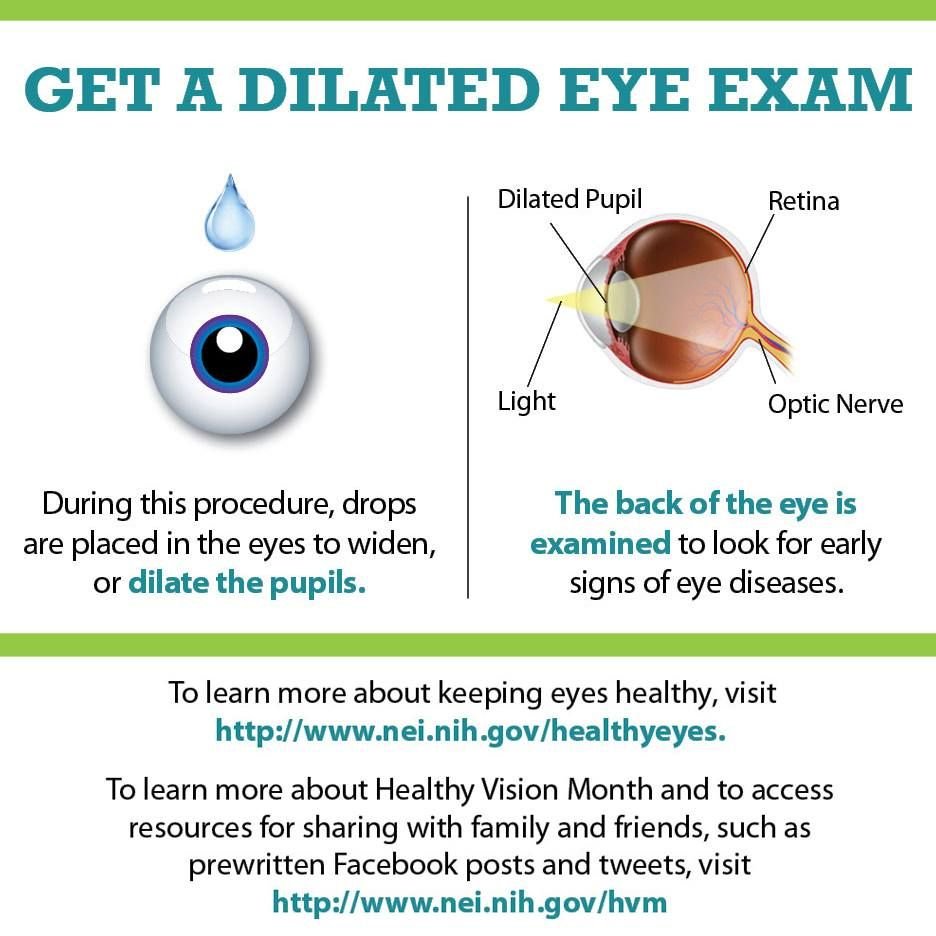
Getting a comprehensive dilated eye exam is one of the best things you can do to keep your eyes healthy. In this painless procedure, an eye care professional examines your eyes to look for common vision problems and eye diseases, many of which have no early warning signs.

Different from the basic eye exam you have for glasses or contact lenses, a comprehensive dilated eye exam can help protect your sight by making sure you are seeing your best and detecting eye diseases in their early stages, before vision loss has occurred.

A comprehensive dilated eye exam includes the following:

• Dilation—Drops are placed in your eyes to dilate, or widen, the pupils. Your eye care professional uses a special magnifying lens

to examine your retina to look for signs of damage and other eye problems, such as diabetic retinopathy or age-related macular degeneration. A dilated eye exam also allows your eye care professional to check for damage to the optic nerve that occurs when a person has glaucoma. After the examination, your close-up vision may remain blurred for several hours.

• Tonometry—This test helps to detect glaucoma by measuring eye pressure. Your eye care professional may direct a quick puff of air onto the eye, or gently apply a pressure-sensitive tip near or against the eye. Numbing drops may be applied to your eye for this test. Elevated pressure is a possible sign of glaucoma.

• Visual field test—This test measures your side (peripheral) vision. It helps your eye care professional find out if you have lost side vision, a sign of glaucoma.

• Visual acuity test—This eye chart test measures how well you see at various distances.

To learn more about comprehensive dilated eye exams and eye health, visit http://www.nei.nih.gov/healthyeyes.

La importancia de hacerse un examen completo de los ojos con dilatación de las pupilas (Healthy Vision Starts With a Dilated Eye Exam)

https://www.nei.nih.gov/learn-about-eye-health/outreach-campaigns-and-resources/outreach-materials/la-importancia-de-hacerse-un-examen-completo-de-los-ojos-con-dilatacion-de-las-pupilas-healthy
Ly Nguyen
Air Pollution Can Cause Eye Problems, Study Shows

Leer en Español:

Según una nueva investigación, la mala calidad del aire aumenta el riesgo de DMRE

New research suggests living in a city with poor air quality increases your chance of developing age-related macular degeneration (AMD)—a leading cause of blindness. The study, published in the British Journal of Ophthalmology, found that residents of highly polluted areas were at least 8% more likely to be diagnosed with AMD than residents of less polluted areas.

AMD develops when the macula, the part of the eye responsible for central vision, is damaged.

How does air pollution cause eye problems?

“This new study shows an association between air pollution and AMD risk, but we still don't know the mechanism involved,” said Raj Maturi, MD, clinical spokesperson for the American Academy of Ophthalmology. “We do know that increased inflammation can increase risk of dry macular degeneration, and pollutants increase inflammatory responses.”

How do I know if I have age-related macular degeneration?

Symptoms include loss of central vision, blurry vision or seeing "wavy" lines.

During the early phases of AMD, people often notice no changes to their vision. Because of this, getting your eyes checked regularly by an ophthalmologist is critical. 

Lower your risk of vision loss from macular degeneration

While some factors may be out of your control, there are several lifestyle changes you can make to lower your risk of vision loss from AMD. These healthy habits include not smoking, eating an eye-healthy diet and exercising regularly.

“We know that our genetics can contribute to almost half the risk of macular degeneration in some people. We, of course can't change this—though there are drugs currently in research studies to address this,” said Dr. Maturi. “The risk factors that we can modify include smoking, high blood pressure and high cholesterol.”

Treatments for eye diseases like wet AMD are most effective with an early diagnosis. Make sure you get regular comprehensive eye examsto lower your risk of vision loss.

👁 Need an eye exam? – call us today!


Don’t let your vision get in the way. If you think your eyesight has recently changed or could be better, set an appointment with Eye Florida at 407-891-2010.


Fax: 407.891.8211 | www.eyeflorida.com


📍Main Clinic | 1330 Budinger Ave, Ste 200, St Cloud, FL 34769


‪📲facebook.com/eyefloridainc‬


📲instagram.com/eyeflorida


#optician #saintcloud #orlando #optical #glasses #eyewear #eyedoctor #ophthalmology #orlandoflorida #eyes #doctor #cataract #orlandoblogger #eyecare #orlandodoctors #eyehealth #sunglasses #health #eyesurgery #frames #eyewearfashion #wellness #vision #optometrist #lakenonaorlando #optometry #eyeexam #orlandohealth

Escrito por Vered Hazanchuk

Revisado por Raj K Maturi MD
Source - AAO.com

Ly Nguyen
Is It OK to Pop a Stye?

No, never pop a stye. This can release bacteria and spread the infection to other parts of the eye. Use warm compresses several times per day to safely reduce and drain the stye. If it persists, see an ophthalmologist who may prescribe medication like antibiotics or drain the stye with surgery.

source: aao

Ly Nguyen